I generated 200 pieces before I noticed every single one was the same piece.
A step-by-step system for producing real volume with AI without producing garbage. Five components you build in an afternoon, nine steps you run every week, and the audit that shows you exactly what happens when you skip them.
Instant PDF download · yours to keep · 14-day money-back guarantee
The numbers this was built from
Almost everything written about AI content marketing is a projection. This is a record. I ran a writing machine at full speed for a month, logged every call with its real cost, then audited the output by counting rather than by reading. These four numbers are what came back.
293,571 words for thirty-two dollars.
Twenty-five days at full speed, logged per call at the time of the call. Generation is nearly free, which is exactly why judgement became the whole job.
That is the finding underneath all the others, and it changes what the problem is. When producing a thousand words costs eleven cents, volume stops being the constraint and judgement becomes the whole game. This guide is built around that.
What a firehose produces
Every piece passed a read-through. I read them as they came out, one at a time, and each one was fine. The problem was invisible at the level of the piece and obvious at the level of the pile, and nobody reads their own pile.
Two hundred titles, one opening word.
Each block is one published piece. All two hundred opened with “The”.
Began with “The” · 200 of 200
One character name, twenty-one times.
Each dot is one short story. Asked for a name with no further instruction, the model returned something plausible, and plausible has a shape.
Named Marina · 22 Every other name · 56
Then it got better, and it still reached nobody. The writing was no longer the problem by then. There was simply nobody in the room, because I had built a machine for producing and none for reaching anyone.
The writing improved. The audience did not.
One hundred and thirteen posts, plotted by engagement. The line is the median. Quality was never the bottleneck.
Median engagement 0.0
Both failures have a fix, both fixes are components, and both components are in this guide. That is the honest reason it exists: I paid for this education by making the mistakes at volume, with the logs running.
The five components
The machine is five things. None of them needs code, an API key, or a subscription beyond the AI tool you already pay for. You build them once, in an afternoon, and then they do their job every time you produce anything.
The brief
The document the machine reads before every piece: who you are, who reads you, which facts are approved, and what you will never claim. Almost every complaint about generic AI writing is a missing brief.
The rotation
A spreadsheet that hands the machine a different combination of topic, angle, shape and title form every time. This is the component I did not have, and its absence is why all two hundred titles matched.
The voice rules
A banned list a stranger could apply without knowing you, plus three positive rules. Taste is not enforceable. A list is. The rules go into the prompt, where they prevent, rather than into the edit, where they only scrub.
The gate
A five-dimension rubric with a threshold, scored in a separate chat before you read the piece. One of the five dimensions cannot be judged on a single piece at all, and it is the one that catches sameness.
The queue
A tab and three folders that keep a person in front of the publish button. Nothing in this system publishes itself, and editing an approved piece sends it back to draft.
You run it
Ten pieces to prove it works, a thirty-minute weekly loop, the distribution step that decides whether any of it reaches a person, and a ledger that tells you the truth about all three.
The nine steps
Each one is something you do, not something you read. Every step opens with what it costs you in time and what you will have when it is done, and closes with a checklist you can tick before moving on.
Then a reference section you keep open while you work: the banned list, the scoring card, a rotation you can copy as it stands, the four prompts in full, the counting method that produced the audit above, and the whole system on one printable sheet.
Read pages from it before you decide
Not a table of contents, not a mockup. Five real pages from the guide, exactly as they render. Open any of them.
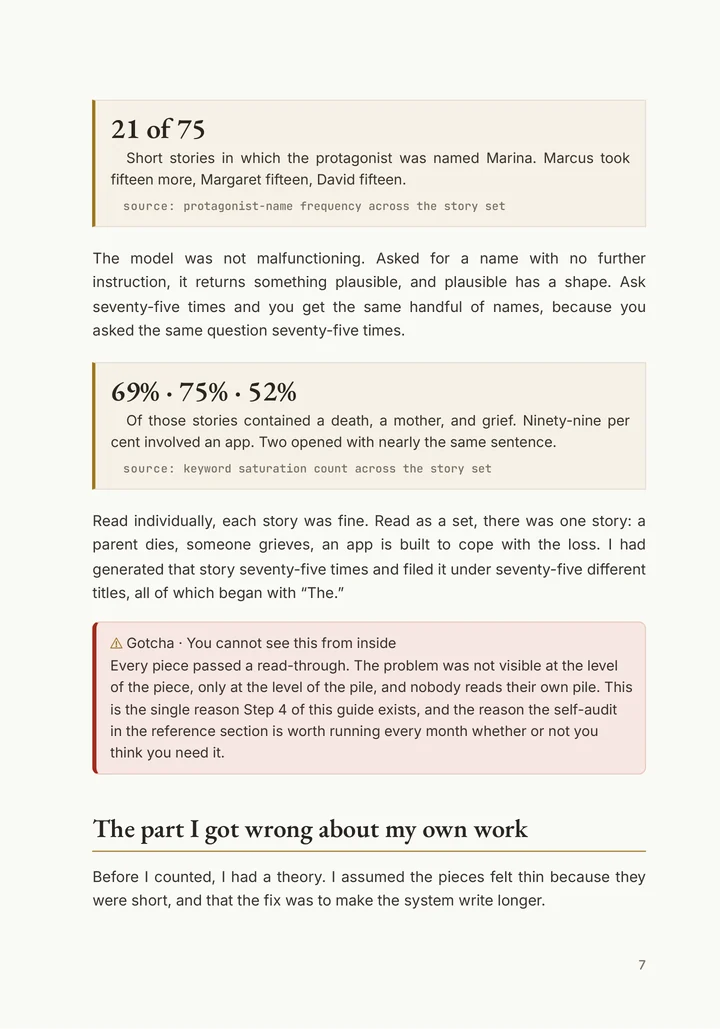 The audit, countedThe page with the numbers on it, including the part I got wrong about my own work.
See the page
The audit, countedThe page with the numbers on it, including the part I got wrong about my own work.
See the page
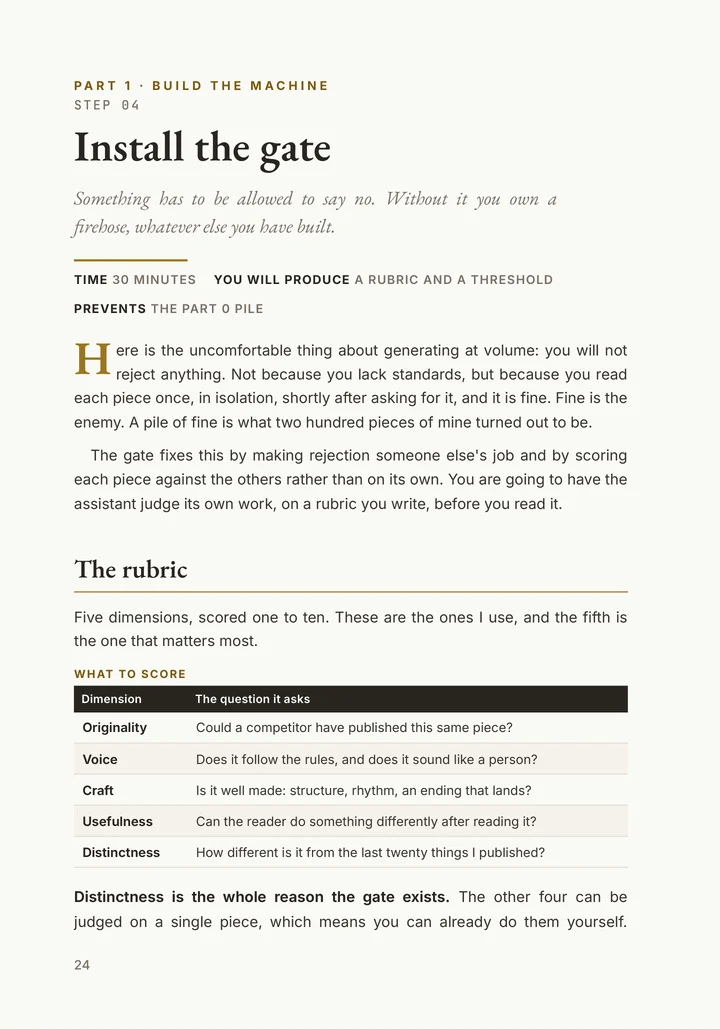 Step 04, in fullHow a step is built: what it costs, what it produces, the rubric, and what it prevents.
See the page
Step 04, in fullHow a step is built: what it costs, what it produces, the rubric, and what it prevents.
See the page
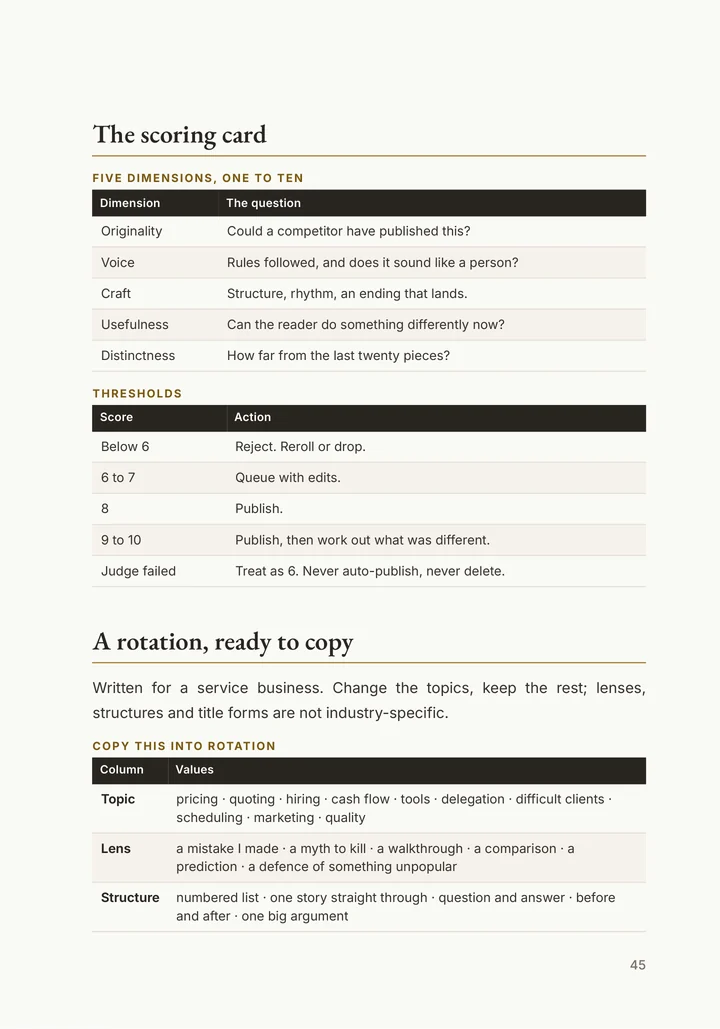 The scoring cardFive dimensions and the thresholds, on one page, ready to use.
See the page
The scoring cardFive dimensions and the thresholds, on one page, ready to use.
See the page
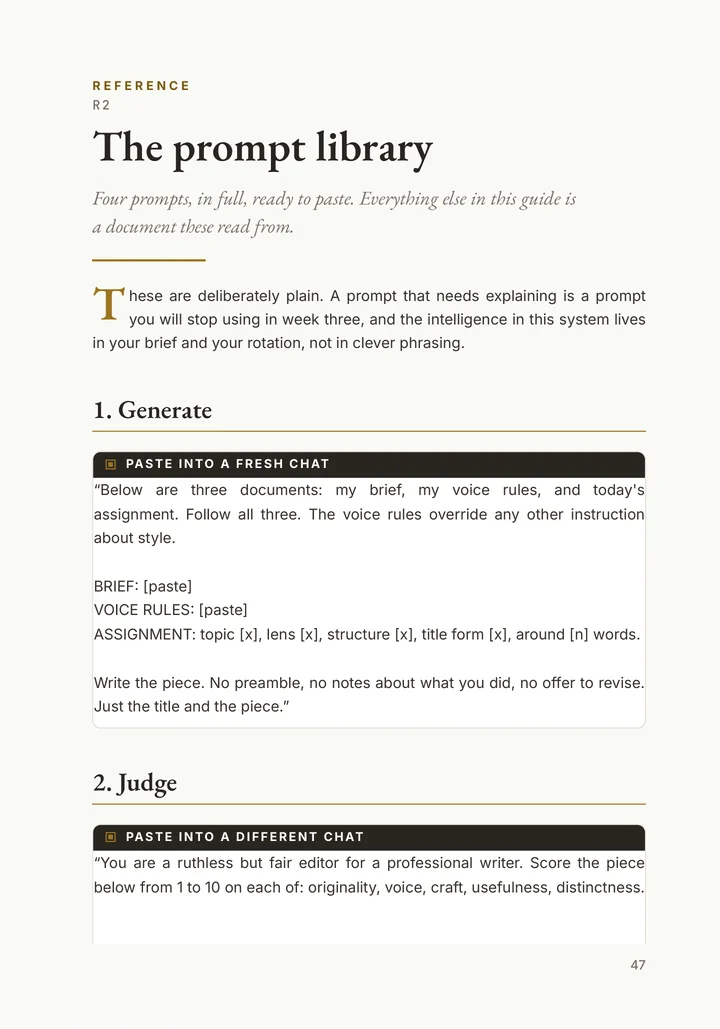 The prompt libraryAll four prompts written out, including the judge and the monthly self-audit.
See the page
The prompt libraryAll four prompts written out, including the judge and the monthly self-audit.
See the page
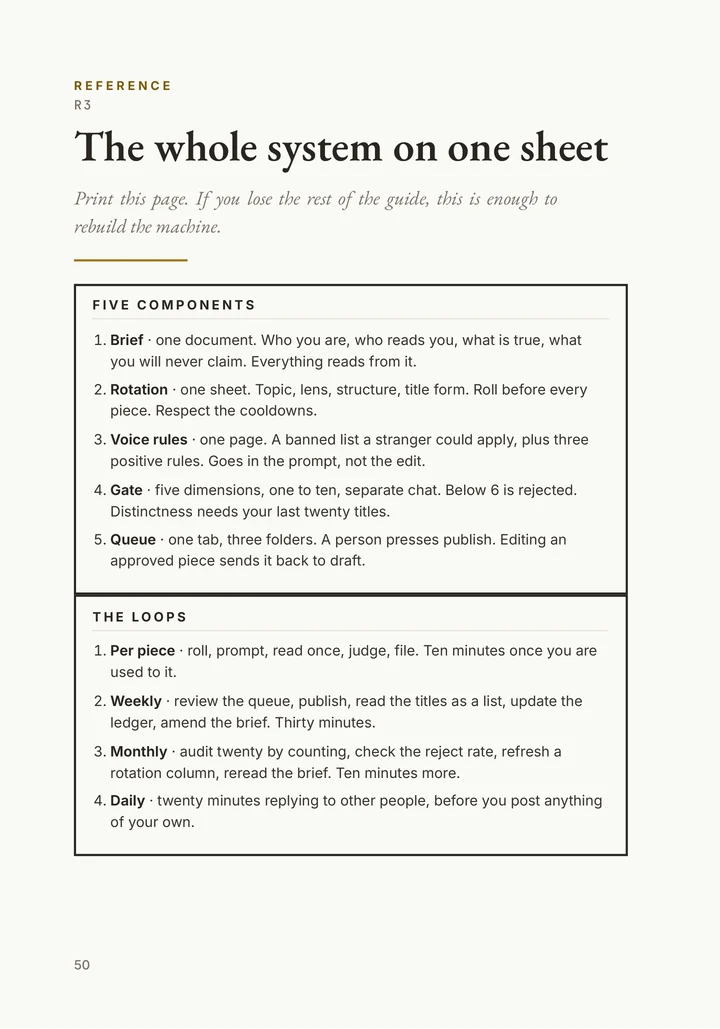 The whole system on one sheetIf you lose everything else, this page is enough to rebuild the machine.
See the page
The whole system on one sheetIf you lose everything else, this page is enough to rebuild the machine.
See the page
Who this is for
Yes, if
You need to publish regularly and you are one person, or close to it. You have tried asking AI for content and been quietly unimpressed by what came back. You would rather build something once than negotiate with a blank page every week. You are willing to reject your own work sometimes.
Probably not, if
You want a tool that posts for you while you sleep. You are looking for the prompt that fixes everything. You publish once a quarter, in which case the machine costs more to build than it saves. Or you want the Python version: this edition is deliberately no-code, and the self-hosted one is a separate product not yet written.
What this is not
Being clear about this up front is cheaper for both of us than a refund.
- Not a promise of a thousand posts. No system of mine produced a thousand of anything, and any page that told you otherwise would be selling you a number rather than a method.
- Not software. You get a guide, and you build the machine yourself out of a spreadsheet, some documents, and whatever AI tool you already use. Nothing to install, nothing to subscribe to, nothing that breaks when a vendor changes an interface.
- Not a growth-hack playbook. The distribution step is three rules and a warning, drawn from watching decent writing reach nobody. It will not get you an audience by Friday.
- Not an argument that AI writing is fine as it is. Half of this guide is a record of what it produces when you leave it unsupervised, which is exactly why the other half is built the way it is.
- Not written by the machine. The guide was drafted, cut and rewritten by hand, which is the least I could do given the subject.
Sent to your inbox the moment payment clears, with a download link that keeps working.
Fourteen days, no questions
Read the whole thing. If you build the machine and it does not change what you are able to publish, reply to your receipt within fourteen days and I will refund you. You keep the PDF either way, because asking someone to prove they deleted a file is theatre.
Frequently Asked Questions
Which AI tool do I need?
Whichever one you already use. The five components are documents and a spreadsheet, and the prompts are plain text with no tool-specific syntax. I run mine on Claude, and nothing in the guide depends on that.
How long before it is running?
An afternoon to build all five components, and about two hours for your first ten pieces. After that it is roughly ten minutes per piece and thirty minutes a week of maintenance.
Is this going to make my writing sound like everyone else's AI?
That is the failure the whole guide is organised against. Step 3 gives you a banned list of the specific tells readers recognise, and Step 4 scores every piece against your last twenty for distinctness before you ever see it.
Do I need to be technical?
No. This edition is deliberately no-code: a spreadsheet, a few documents, and copy-paste. I built my own version in Python, and that is described as background rather than as something you have to reproduce.
What is the difference between this and The Claude Operator's Manual?
The manual teaches one tool in depth: projects, skills, connectors, the API, Claude Code. This teaches one job: producing publishable volume, on any tool. They overlap almost nowhere, and plenty of people will want both.
Will there be a version with the code in it?
Probably, as a separate product. This edition covers the method, which is the part that transfers. The Python implementation is specific to my machine and my file paths, and shipping it as though it were plug-and-play would not be honest.
How do I get it?
Instantly. You pay, you land on a page with the download, and the same link arrives by email so you can come back to it later.
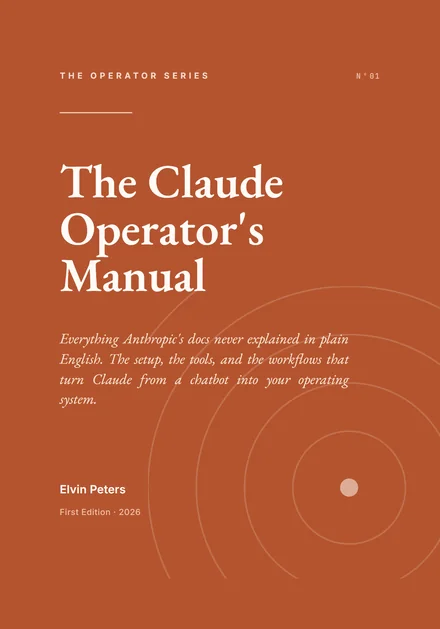
Running Claude for the writing?
This guide is about the system. The Claude Operator's Manual is 217 pages on the tool itself: projects that hold your brief, skills that run your rotation, and the API for when the chat window stops being enough.
See the manual →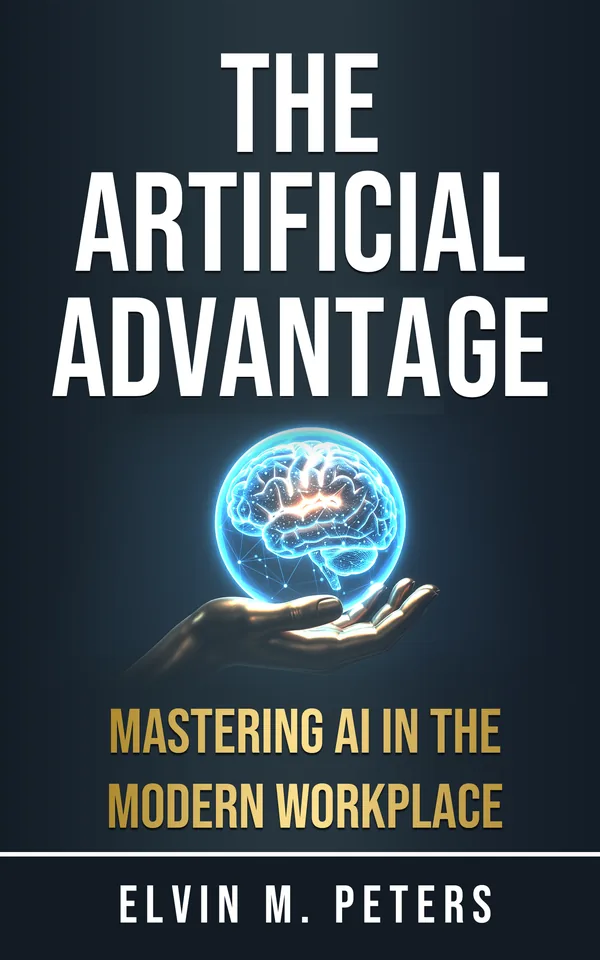
New to directing AI at all?
The book teaches the skill underneath all of this: how to brief any model the way you would brief a sharp new hire. If the word “brief” in Step 1 sounded unfamiliar, start there.
See the book →The quality gate, before you buy anything
The banned-phrase list I run every piece against, and the scoring rubric a draft has to clear before I ever see it. One printable page from inside the guide. Run it against anything you wrote this week.
One email, one PDF. Unsubscribe in one click.